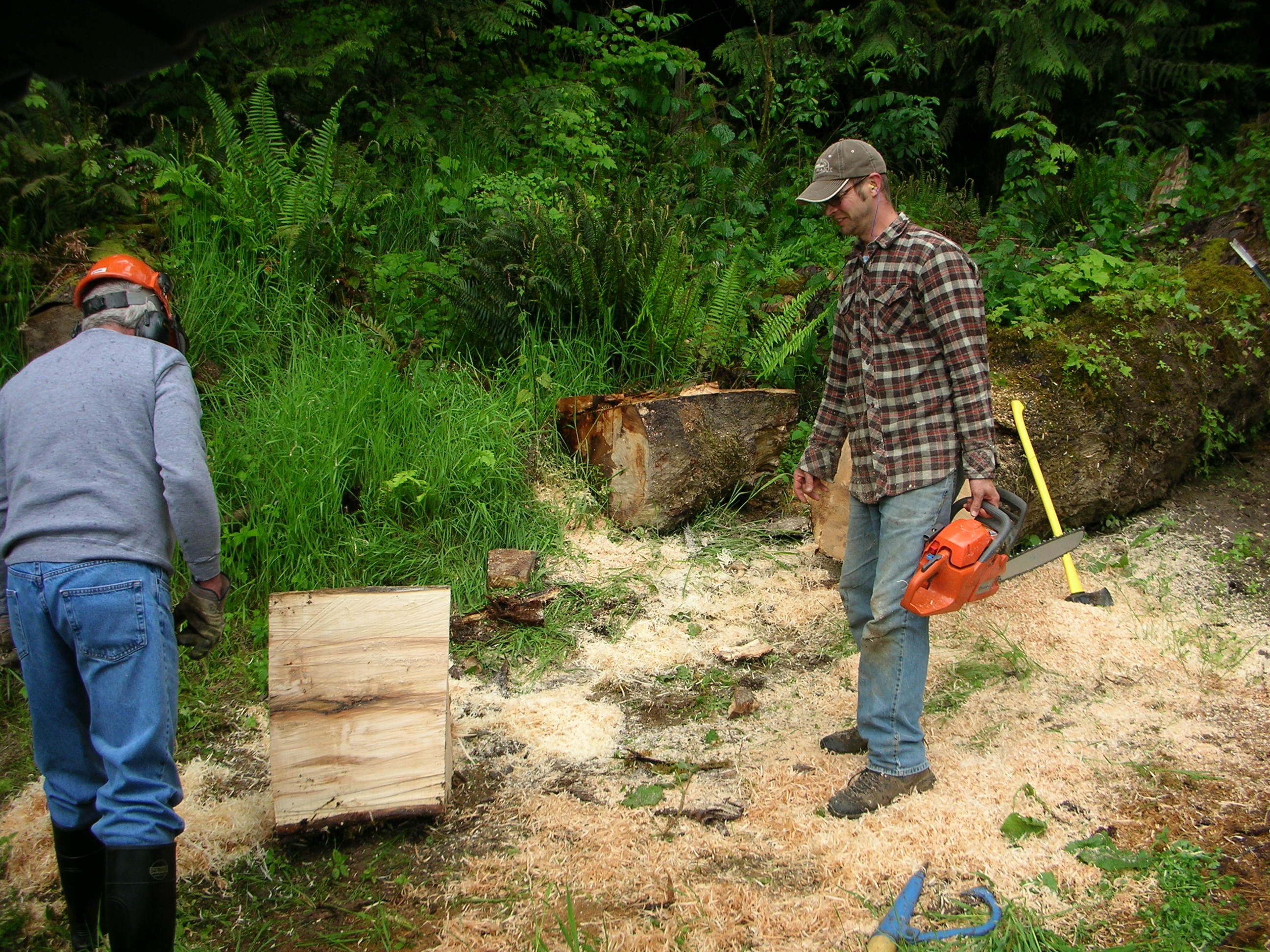
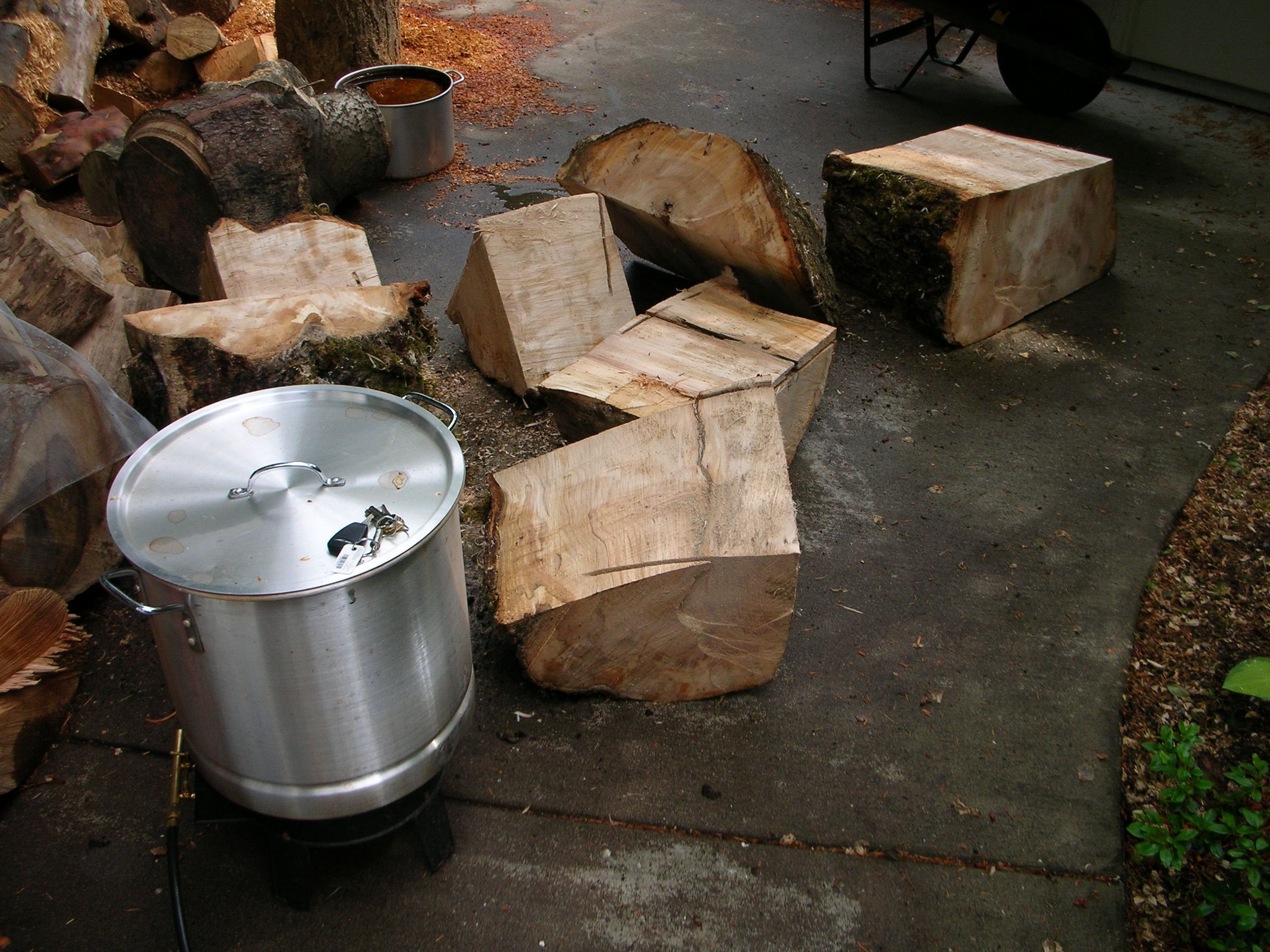
It all starts in the forest harvesting the wood. This maple tree came down in a storm. It has both figure and burl.1: Always use sharp tools and proper eye protection. Recommended tool for rounding up a log is a 5/8 inch D-way bowl gouge. Smaller gouges will work; it will just take longer to accomplish your task. Bark will dull your tool faster so be aware and keep your gouge sharp while rough turning.
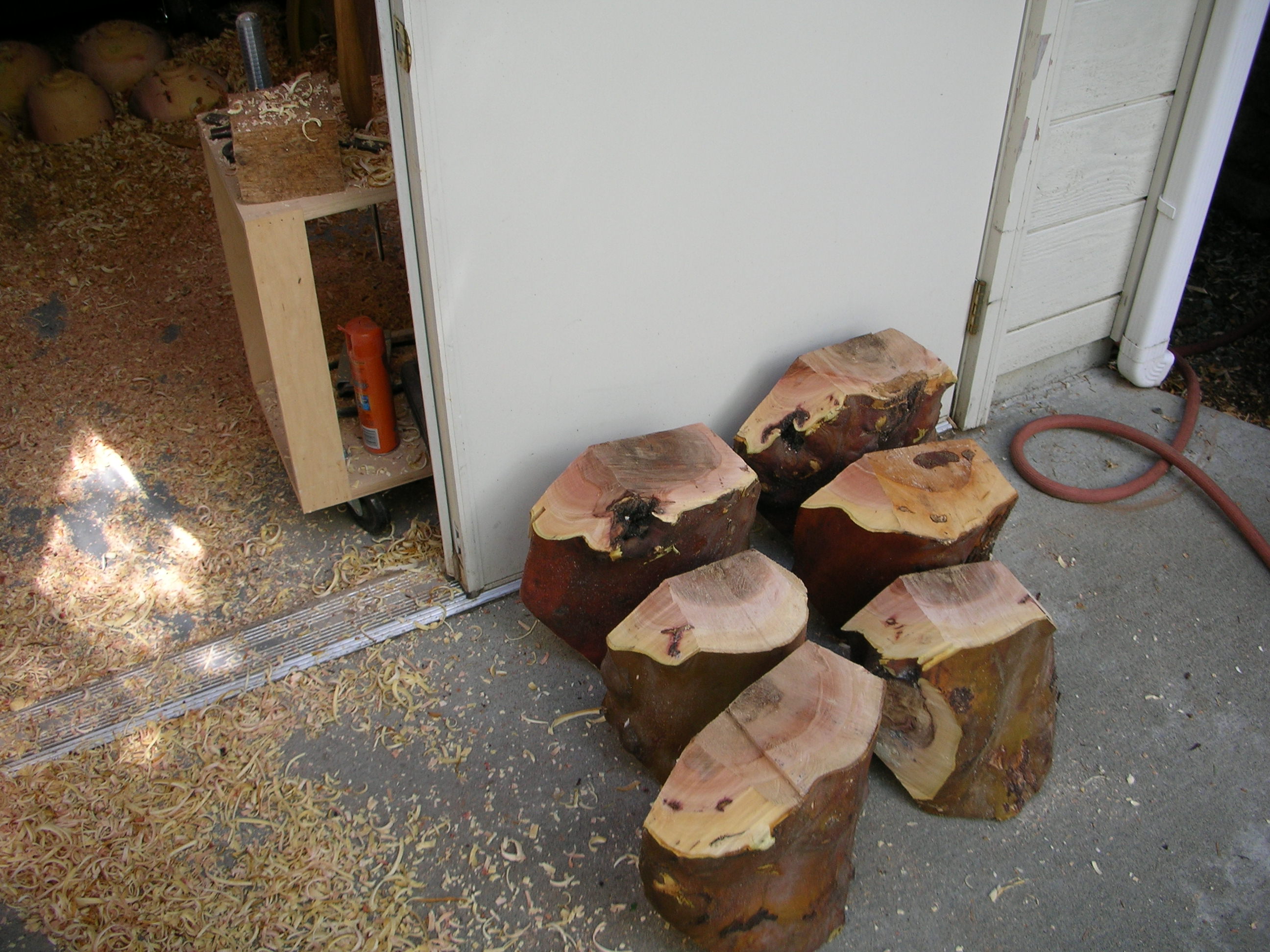
Prepped Madrona logs for turning2: Begin by cutting the log with a chain saw. I always cut the corners off of larger logs that are over fifteen inches; any smaller and it is just as fast on the lathe. I never use a band saw for large wet logs. Typically I put the center of the log to the drive center and the outer part of the log to the tail stock, unless a natural edge bowl is desired. If a natural edge bowl is desired then the bark in the middle of the log should be removed for the drive center to make good contact with the meat of the log.
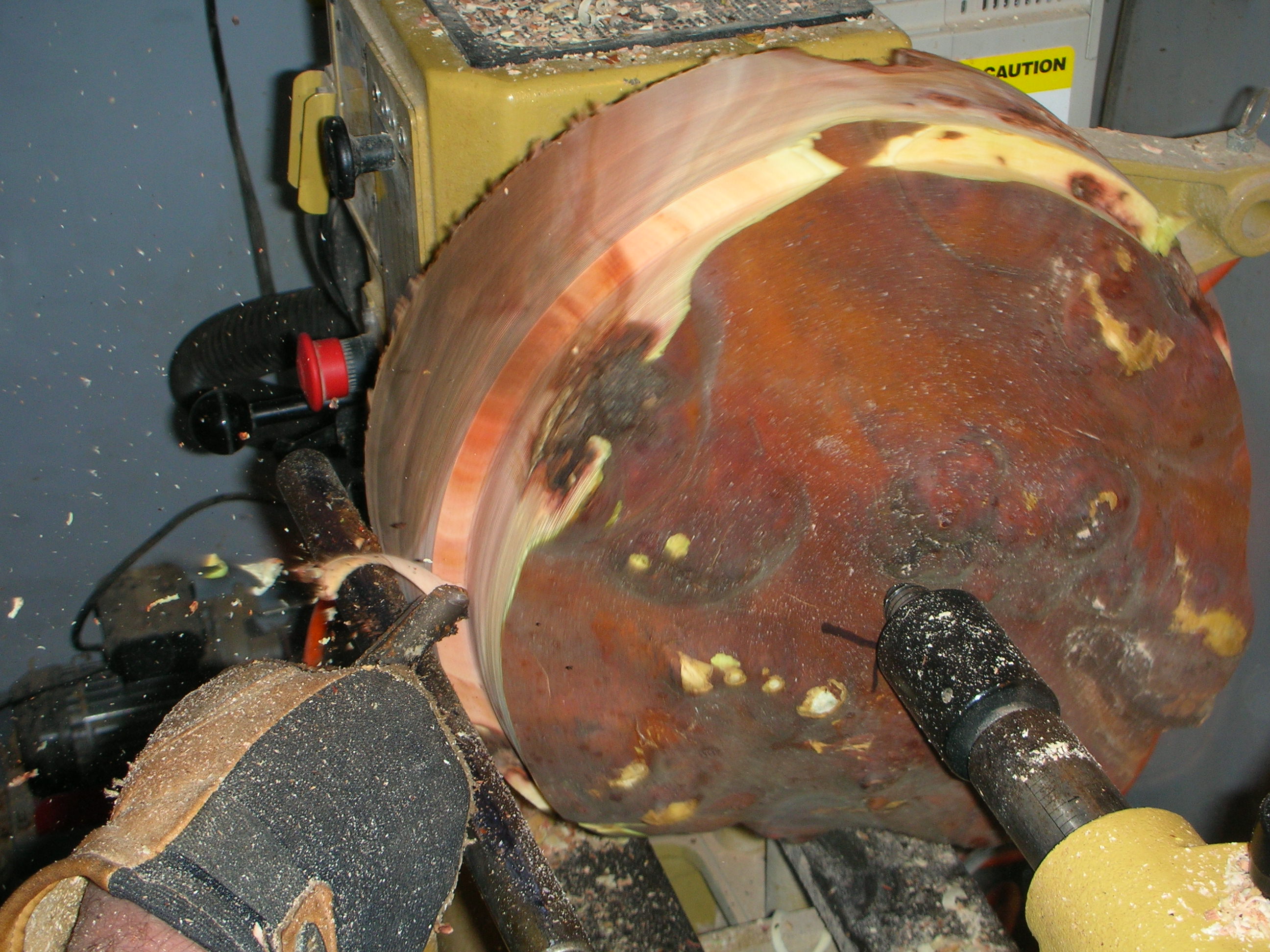
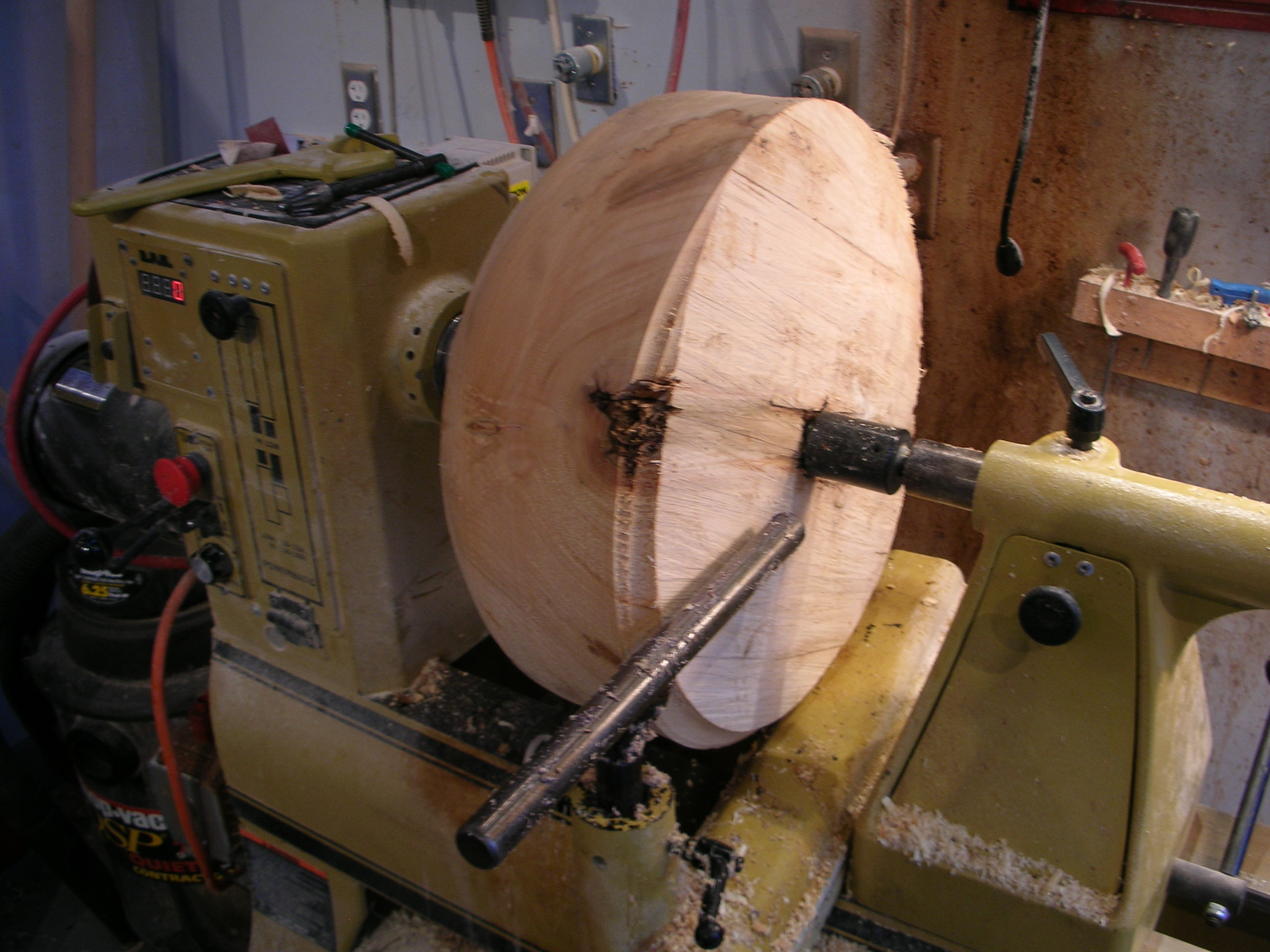
Rounding the log using a 5/8 inch bowl gouge, held horizontally riding the bevel using all of the cutting edge.3: Begin turning between centers using the largest drive center that you have. Spin the log as fast as your lathe can handle without vibration. Tighten your tail stock often during this process. As much as possible begin by working your bowl gouge held horizontally and cutting towards the drive of the lathe. The bevel of the gouge should be parallel to the direction you are cutting (This is called riding the bevel.) The cutting edge should be at about 30 to 40 degrees from vertical. Remember to work your gouge slowly at first; just because you are cutting a lot of air does not mean that you should move fast. Take as much wood as your gouge will allow. This will make for a balanced cut and it will be easier on you physically. When the log begins to become round you will be amazed at how fast you will be able to round the log completely. This method is much easier on your body and safer than using the typical large bowl gouge and standing facing the side of the bowl/log. It can be used for rounding any log for turning even if you are rounding for a hollow form.
4: After the outside of the log is round then reverse the direction of your cut and begin to form the tenon. First round the bottom of the bowl to a proper shape. At this point I typically change to my ½ inch gouge and I use a shear cutting approach by lowering the handle once the cut is begun.
Prepped log ready to rotate and either core or hollow to bowl shape.5: Forming the tenon can be very simple. Know your chuck. Find the optimum size for the tenon where the teeth of your chuck will make the most contact with the wood. Measure the size required for your largest chuck and make a small tool gauge so that it will be easy for you to size while you are turning. Make sure that you have removed the soft wood that runs along the bark so that the tenon will be strong and your bowl will not take a flying leap while turning. Try to make these cuts very smooth and clean. The outside of the tenon should be a clean 90 degrees or dove tail depending upon your chuck so that the chuck will have a firm base of support for your bowl.
6: Always make clean shear cuts on the outside of the bowl for proper drying later. The best way to learn to cut clean bowls that are dry is to practice your techniques while turning wet wood.
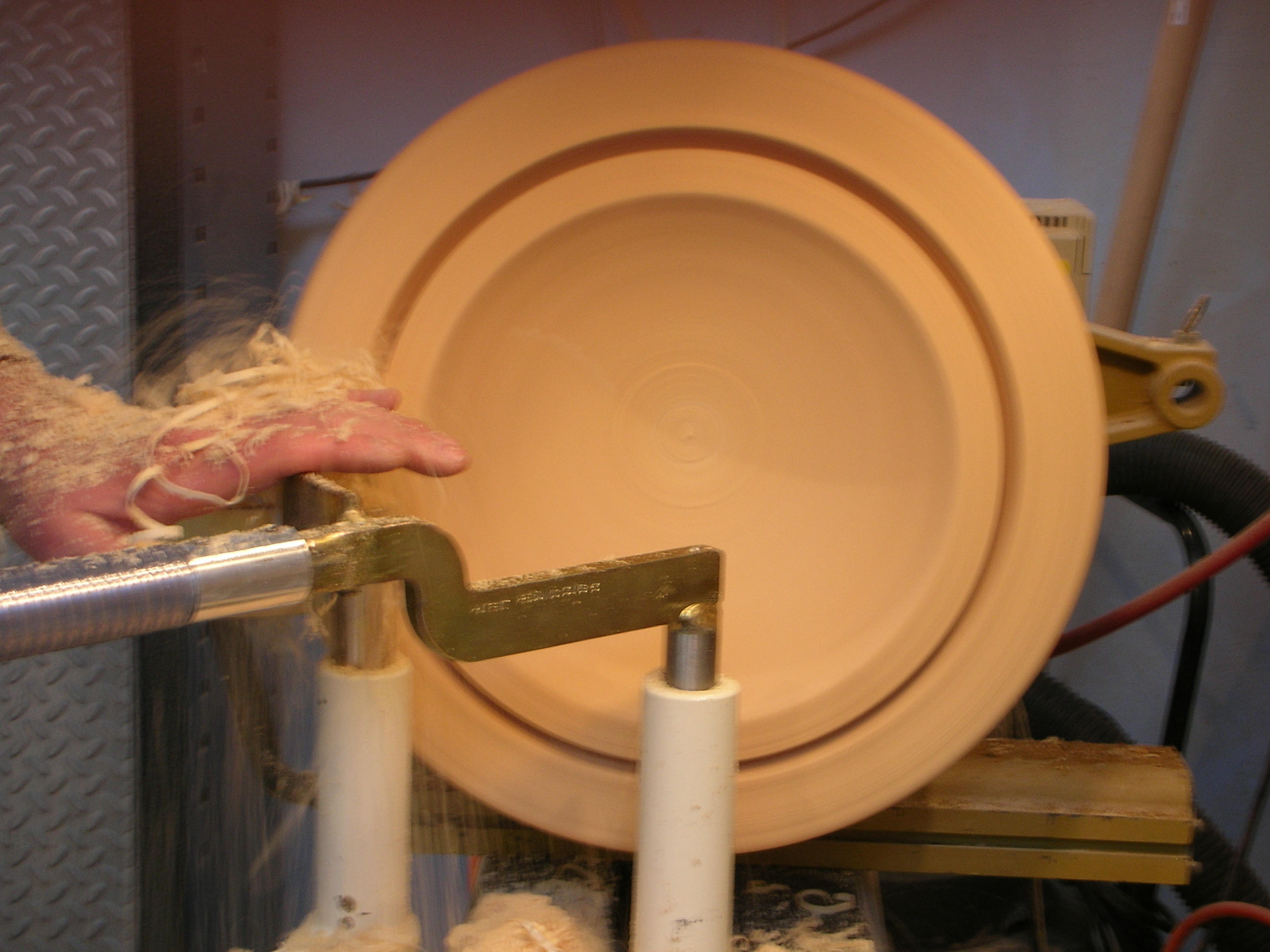
Bowl blank in the chuck and ready to prep the rim side. Note the bark enclosed area; I will remove all the wood to that point for a better final outcome for the bowl.7: Once the outside of the bowl bottom is cleanly cut and the tenon is perfect remove the log from the centers and install your chuck and mount the log/bowl on the lathe in the chuck. At first use your tail stock to add strength for turning. At this point finish smoothly turning the outside of the bowl to the desired shape and make sure that the outer edge/lip of the bowl is slightly rounded over for proper drying. Smooth cut the top of the bowl flat.
Coring the bowl with a Oneway corer.8: Now the inside of the bowl is ready for turning. Either core out as many bowls as possible or begin using your gouge to cut the inside of the bowl. By riding the bevel cut from the outside to the center of the bowl. A normal grind for your bowl gouge works great for the outer edge of the bowl, however for the center it is best to use a bowl gouge with a flatter more compact grind. This type of grind allows you to cut cleanly while riding the bevel all the way to the center of the bowl. The way to use a gouge by riding the bevel is to establish an edge and then ride that edge with the bevel using the bevel as a steering devise for cutting the curve. You guide the tool using the handle and turning the cutting edge so that the desired cut can be established. Practice makes perfect and it is best to practice with wet wood.
9: The bowl thickness is always an issue. For normal air drying the thickness should be approximately 10% of the diameter of the bowl. Therefore, a ten inch bowl would be about one inch thick. Always try to turn your rough bowl an even thickness for better drying and of course remember to round the edge of the top rim of the bowl, both inner and outer edges.
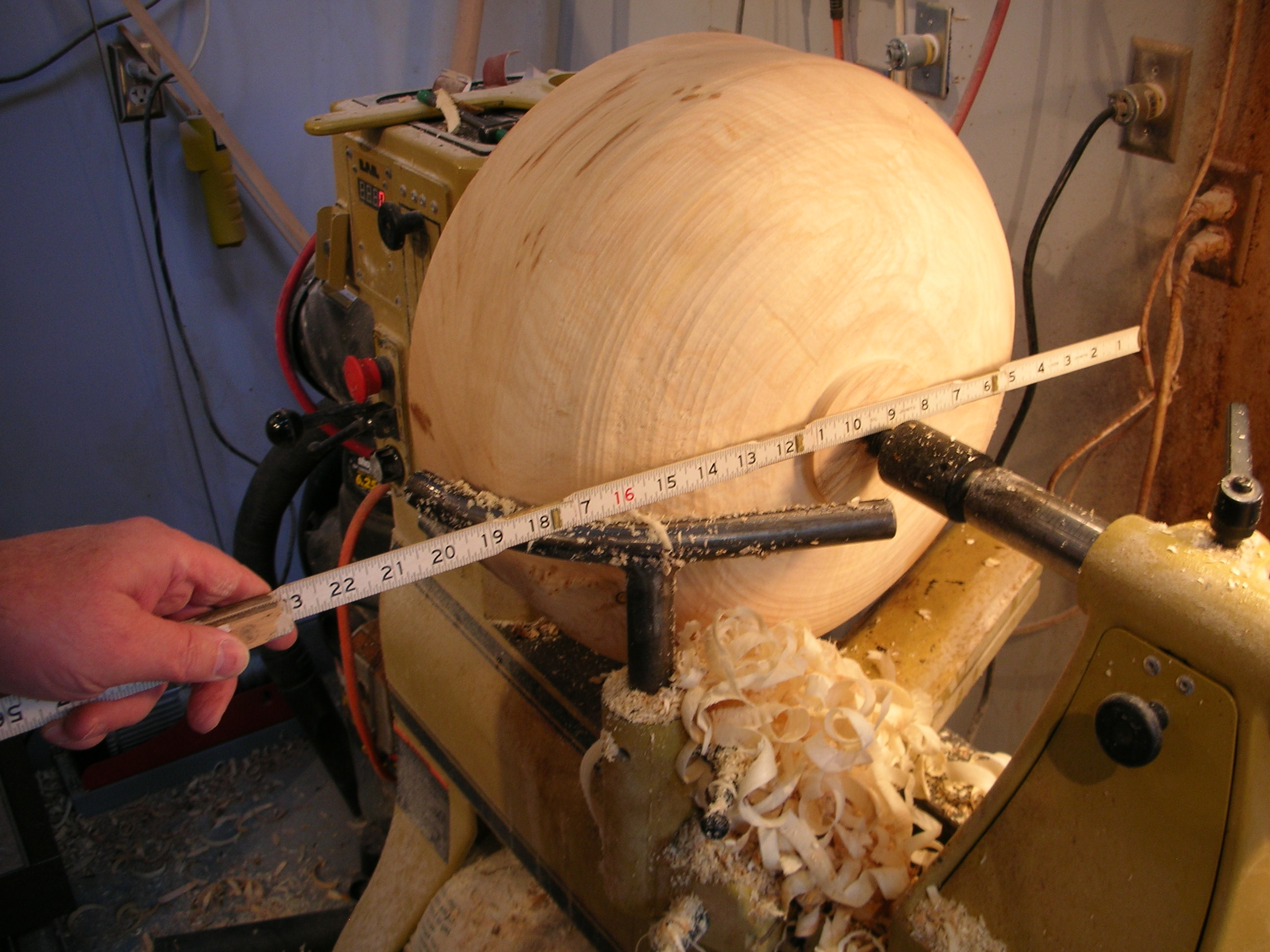
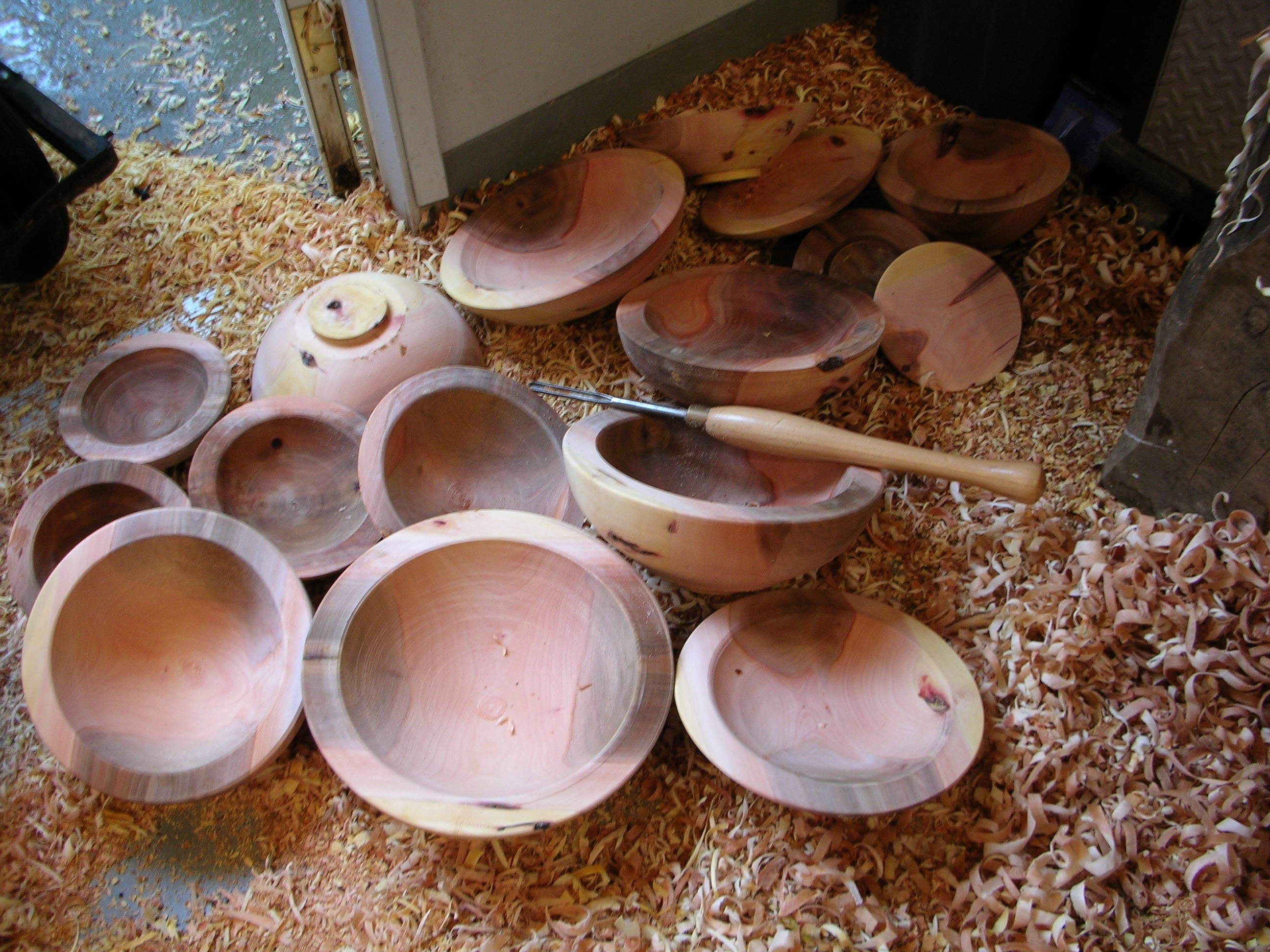
Results of three hours of turning.10: Drying of most woods is quite simple all you need is patience. What I have found is that when I started I just kept turning wet bowls to satisfy my turning needs and hone my skills and now I have an inventory of dry bowls. At this time over 100 bowls that are either dry or drying. You simply cannot rush this process if you want to preserve the vibrant colors of the wood. Boiler and Maple harvest.Madrone or Madrona and fruit woods require special handling. They require boiling or pressure cooking for one to two hours and then quenching in cold water until cool throughout. After that process they along with all other woods should be placed in an airy environment to dry slowly. Again the Madrone and fruit woods will require monitoring for the first few weeks on at the very least a daily basis looking for splitting and using CA glue to stop any splitting at the onset. This splitting problem will go away and then you just leave them for several months until they are thoroughly dry.
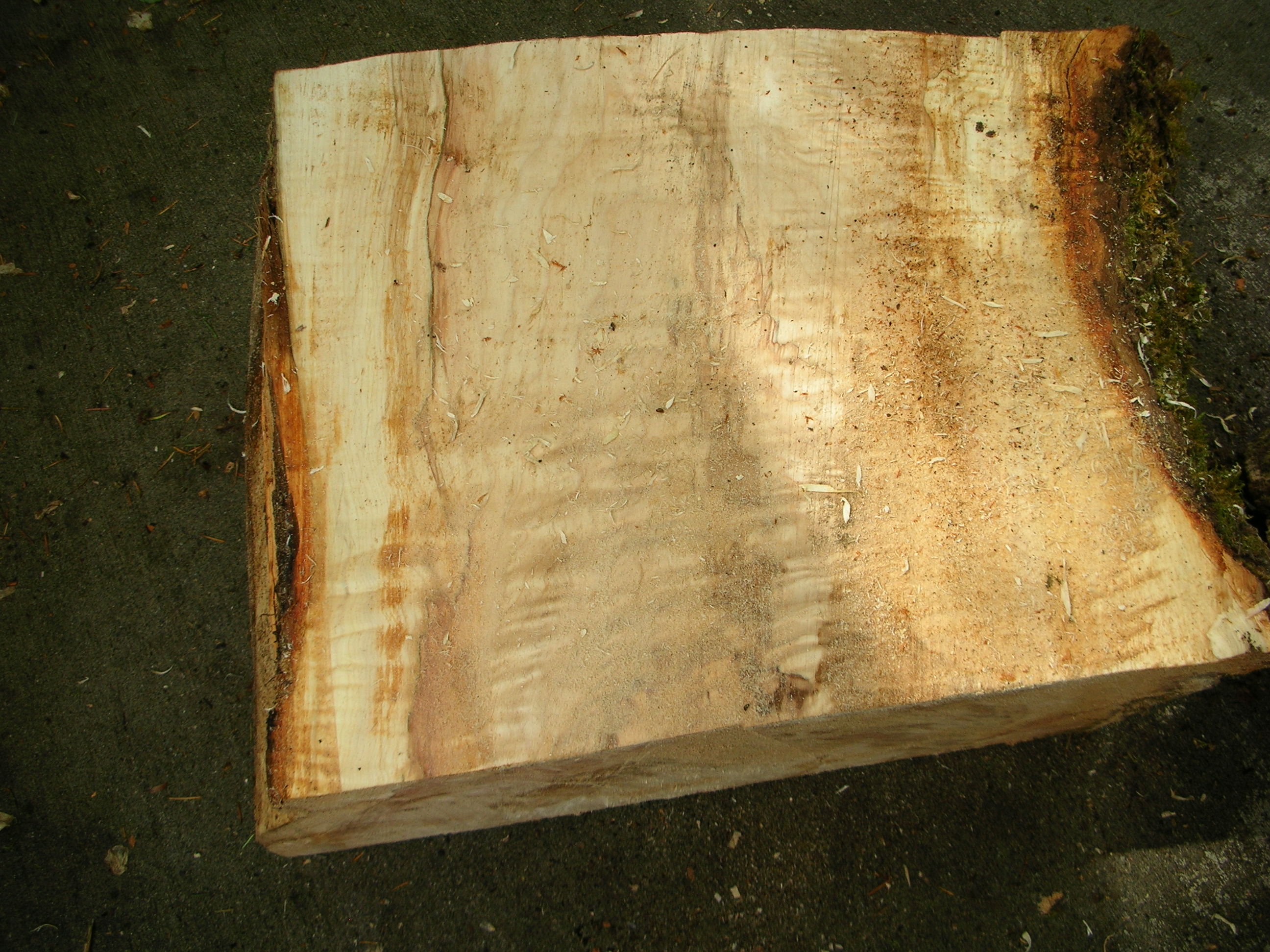
figured mapleA quick note about reading wood. Here is a photo of Maple showing the figure or curl on the outside of the log. Burl is easy to see but, seeing figure requires the bark to be stripped away. Note the waviness of the wood. That photo was of the wood used to make the urn in this months newsletter.
Cutting The Dried Bowl
1: First the bowl is jam chucked and the tenon is re-turned making sure that it is smooth and again at 90 degrees or dove tail and that the size is still good for your chuck.
2: Mount the bowl in the chuck and establish the bowl rim again riding the bevel towards the center of the bowl. A shear method is always recommended. If necessary reverse the gouge and approach the bowl with the cutting edge facing the bowl at a severally vertical angle and cut from the center out to the edge with gentle cuts and good tool control. At this point it is sometimes advisable to make one clean cut of the center of the bowl and then put it back on the shelf for a week or three to alleviate stress in the wood. If you are dealing with a wood that tends to move even after drying like Cherry it is always advisable to do this at least once and I will even cut the outside of the bowl as well for Cherry. Then I let it rest for another month or three. If when I mount it back on the lathe the bowl is out of round I make another thin cut and back on the shelf for another while. Patience is so hard at times, but it is best when turning wood.
3: Now is the time to cut the shape of the outside of the bowl. Using a shear cut tool angle and riding the bevel make the outside of the bowl round. Then perfect the shape to the desired curves. If you are going to do any special treatments to the outer bowl like beading, now is the time to do so. I always pre-finish the outer surface before beading. That means that the bowl surface is shear cut and sanded to finish grade. Before beading I usually make one cut of the inside of the bowl just to round it and not to thin it. This makes the bowl turn more evenly and makes any fine cuts easier on the outside. This would also be the time to do any edge treatments such as angled bowl cuts to the front lip of the bowl creating semi circles. Before doing this type of cut I pre-finish the edge as well, but leaving the thickness of the bowl to add stability. Before moving on to the finishing of the inside of the bowl make sure the outside is exactly the way I want the finished bowl to be including the outer rim. When satisfied with the outside then I move on to the inside. I will often even sand the outside before proceeding to the inside, but it is not necessary.
4: Turn the inside lip of the bowl with a smaller diameter bowl gouge with an aggressive grind and then keeping an eye on the outside of the bowl I ride the bevel and cut the inside. First taking away the bulk of the material and then really watching carefully as the gouge is guided riding the bevel to cut the perfect line that follows the outside curves of the bowl. For large bowls it is essential that you work your way towards the center of the bowl, working perhaps two inches of bowl at a time. When the first two inches are perfected and only then you move onto the next two inches. This method continues until the inside is complete. Curves are the key. The curves must be natural and flowing to be appealing and easier to finish than abrupt curves. For this cutting I use my ½ inch D-way gouge for the inside sides and then change to my ½ inch D-way blunt grind gouge for the deeper inside curves. On larger bowls I will use my 5/8 inch blunt grind D-way gouge for greater stability if the tool rest does not get back in the bowl far enough.
5: Now is the time to sand and finish the bowl. This is an individual choice as to finishes. I usually power sand using an angled drill motor and a hook and loop sanding system. I have found that it is best to use the finest grit necessary to make the wood smooth. If after sanding you find that there are still imperfections then immediately drop back two grit levels rather than punish the wood. After attaining a smooth surface then sanding may proceed more quickly from one grit to another. I usually sand to 400 and then soak the wood with denatured alcohol. I quickly hit it with 400 and then 600 and finish with a 3M Scotch-Brite pad.
6: The bowl is then turned and vacuum chucked for turning and finishing the foot. I then sign and name the wood and touch up with the Scotch-Brite pad. At this point I apply whatever finish I plan to use. I have also been known to put the finish on the balance of the bowl before turning the foot. This does help secure the wood with the vacuum chuck because of the sealing effect of the finish. Waxing the bowl is the final step. Renaissance wax is my choice for waxing. It is easy and extremely effective and does not show fingerprints.
This website uses cookies to improve your experience. We'll assume you're ok with this, but you can opt-out if you wish.AcceptRejectRead More
Privacy & Cookies Policy
Privacy Overview
This website uses cookies to improve your experience while you navigate through the website. Out of these cookies, the cookies that are categorized as necessary are stored on your browser as they are as essential for the working of basic functionalities of the website. We also use third-party cookies that help us analyze and understand how you use this website. These cookies will be stored in your browser only with your consent. You also have the option to opt-out of these cookies. But opting out of some of these cookies may have an effect on your browsing experience.
Necessary cookies are absolutely essential for the website to function properly. This category only includes cookies that ensures basic functionalities and security features of the website. These cookies do not store any personal information.


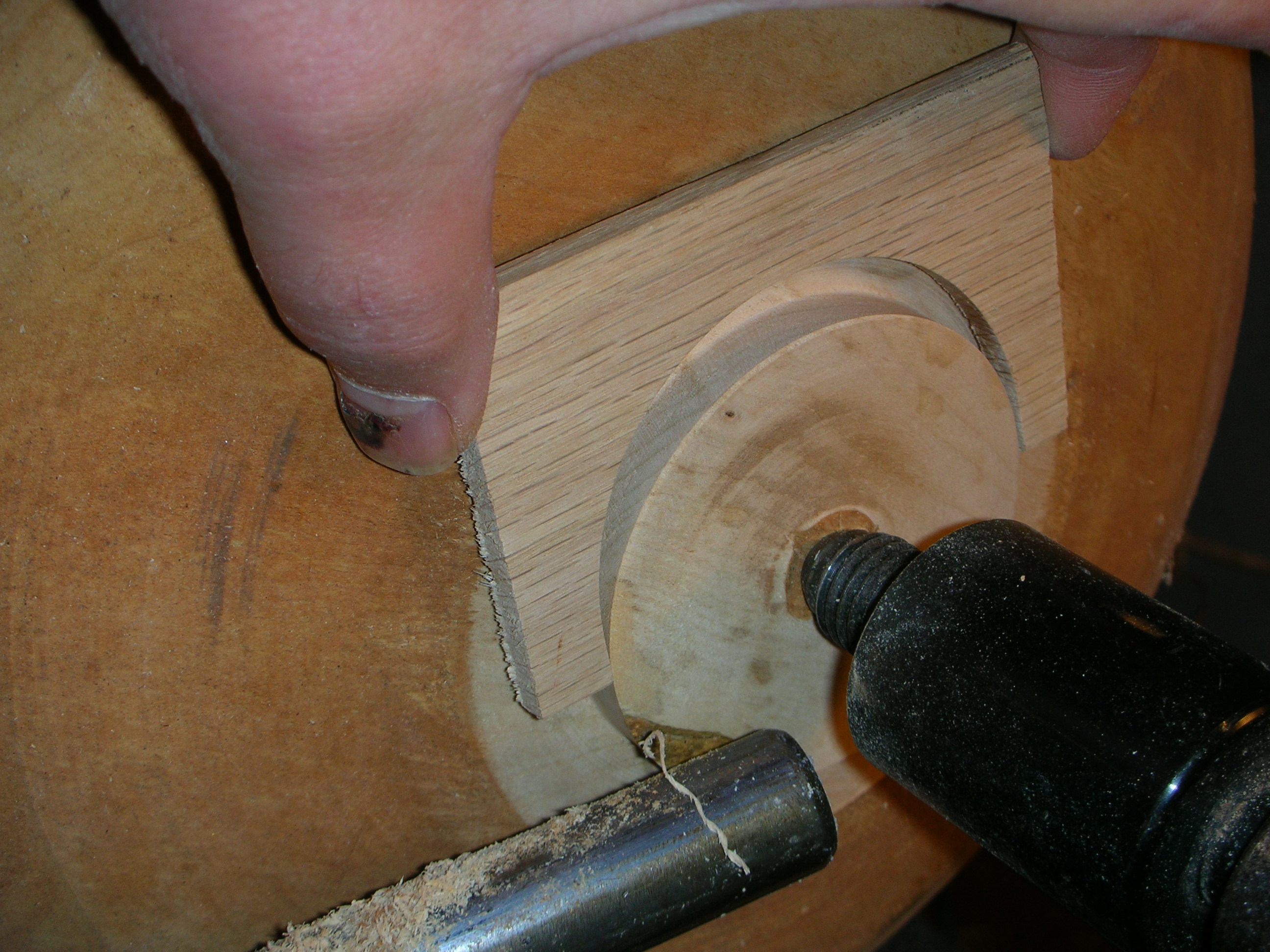 1: First the bowl is jam chucked and the tenon is re-turned making sure that it is smooth and again at 90 degrees or dove tail and that the size is still good for your chuck.